
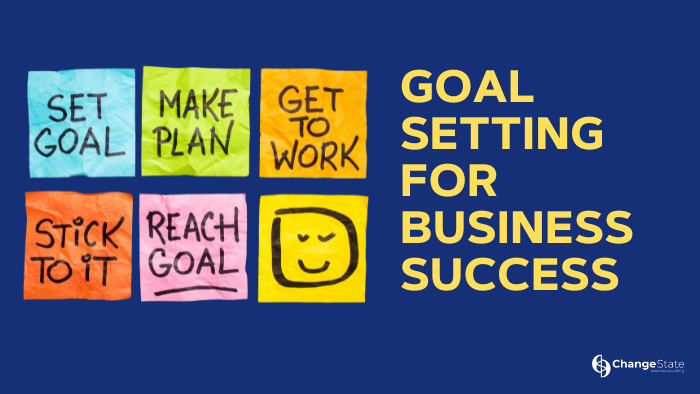
How To Set, Chase, And Grow Into Goals That Actually Matter
Running a business without clear goals is like jumping in your car, turning the ignition on, and just driving.
You are moving… You are burning fuel… But you are not necessarily going anywhere that matters.
And in business it’s kinda the same but when your fuel tank is empty it leads to burnout, or repeating the same year on loop, doing the same thing but expecting different results.
Goal setting is not about ticking boxes or writing a wishlist. It doesn’t need to be all or nothing.
It’s all about giving your effort direction and giving your brain a target to work with, creating clarity, confidence, and structure so you can build the business and life you want on purpose, not by accident (pun intended).
Giving your effort direction and giving your brain a target to work with.
In this guide, we will look at:
- Why goals matter more than you think
- How your brain actually helps you when you set goals
- Why the journey is not a straight line
- How to use the SMARTY framework
- and how to think about progress using Gap vs Gain
Why Goal Setting Matters More Than You Think
Most business owners are not short of effort. In fact all the business owners I meet and work with are exactly the opposite. However, they work and try so hard that they are engulfed by all the doing that needs to be done, that they don’t have time to think strategically – which makes them short of direction.
However, continuing on this path without clear goals ends up with you:
- Saying yes to everything
- Putting out fires all day
- Working harder, but not getting closer to what you actually want
Goals give you a way to check every decision against something that matters.
What goals actually do for you
- They create direction
Goals act like a compass. When an opportunity, problem, or shiny idea shows up you can ask yourself “Does this move me closer to my goals or further away from them?” - They create focus
Focus is about deciding what you are going to do and what you are going to let go of.
Without a goal, everything feels equally urgent. With a goal, you can prioritise. - They build momentum
When you take steps toward a goal and you can see that you are getting closer, you naturally want to keep going. Progress feels good, so you keep wanting to do more. - They give you honest feedback
If your efforts are not moving toward your goals, something is off. It could be the goal, the plan, the habits, the timing, the resourcing, or your mindset. Take the feedback and make the changes. - They reconnect you with your why
Well chosen goals remind you why you started your business in the first place.
Maybe you wanted flexibility, choice, financial security, impact, or the ability to design your own life. Goals tie the day to day back to that bigger picture and help you move closer to it.
Two Types of Goals
Before you start writing goals, you need to understand what motivates human behaviour. There are two types of goals that we use to motivate ourselves
- Move towards goals
- Move away from goals.
Most people starting out with goal setting start with moving away from goals because they are usually in pain or dissatisfied and want to make a change (stop working late nights etc), This is a short term goal setting strategy that helps build momentum.
However the best type of growth happens when you have a move towards goals, where you have a positive vision of the future you want to live. These types of goals are the goals that pull you forward.
If You’ve Never Set Goals Before
Many people get stuck because they try to set huge ambitious goals with no practice, no structure, and no belief yet.
Start small and start with moving away from goals and build your goal setting muscles first. You can’t run a marathon without training and running your first 5kg. The same principle is applied in business and with goal setting. Choose something you can achieve in the next 30 days and then expand onto 90 day sprints. Once you nailed that you can then start the bigger picture thinking with:
- 1-year goals — what would make next year feel successful?
- 3-year goals — what direction are you heading?
By the time you’ve built the muscle and momentum for goal setting, you’ll naturally develop a long-term big picture thinking.
But it comes later – not first.
How Your Brain Helps: The RAS
Our brains aren’t designed to notice everything, it simply cannot and quite frankly we would be overwhelmed and overstimulated (yes, more than we already are) so, Instead, it uses a filtering system called the Reticular Activating System (RAS).
The RAS filters out what is important and what to ignore based on what you repeatedly think about.
You’ve experienced this when:
- You decide to buy a car – suddenly you see it everywhere
- You start renovating – suddenly you notice more trades on the road
- You start thinking about having a family – suddenly you see babies and prams everywhere
Those things were always there all along
Your brain just was not tagging them as important.
What this means for goal setting
When you set clear, specific goals and keep them in front of you:
- Your RAS starts noticing information that helps you achieve them
- You see possibilities, connections, people, and ideas you would have missed before
For example:
- You set a goal to increase profit. You suddenly notice waste, poor pricing, or inefficient processes.
- You set a goal to work fewer evenings. You start seeing tasks you could delegate or stop doing.
- You set a goal to improve your leadership. You notice moments where you hold back, avoid conversations, or default to doing it all yourself.
This is why vague goals don’t work. Your RAS needs something clear and specific to work with – so that it can identify all the opportunities to help you make it happen.
Beware – Goals Aren’t a Linear Process
On paper, goals look like this:
Set goal → Take steps → Achieve
What people don’t tell you is that in real life, it looks and feels like a zig zag up a steep mountain:
Start strong → Get distracted→ Hit a roadblock → Adjust → Move forward → Get knocked sideways → Learn → Try again → Move forward a bit more
And eventually… achieve.
That is not failure. That is the process.
Why accepting the zig zag matters
When you think progress should be straight and smooth:
- You beat yourself up when you slow down
- You think you are a failure, and goal setting doesn’t work
- You are more likely to give up entirely
When you expect the zig zag:
- You see challenges as feedback, not proof you are not good enough
- You tweak the plan instead of abandoning the goal
- You become more resilient and creative
A goal is meant to challenge and grow you. The goal of a goal is to keep moving, even if it is sometimes sideways. As long as you are moving towards the summit. Sometimes it won’t always feel or look as good as you had it on paper.
How To Actually Write a Goal
The SMARTY Framework
To ensure you have a solid goal we use the SMART Framework. We ensure that we can tick off each letter against the goal, and that will guarantee that you have written a solid goal.
S – Specific
What exactly do you want to achieve?
Avoid vague, high level language – get really specific.
Eg. change – I want more profit to increase my net profit. Before these are 2 different types of profit recorded on your profit and loss statement. You need to get really specific about which one you wanted to increase.
M – Measurable
How will you know if you are on track or if it is done?
What numbers, milestones, or indicators will you track?
Now we add a measurable one, eg. I want to increase my net profit to 20%. So we will know we have achieved the goal.
A – Achievable
Is this realistic for your current situation, or is it fantasy land?
You can stretch yourself, but it should be something you genuinely believe is possible with focused effort.
In this example we will assume the position that it is achievable.
R – Relevant
Does this goal matter now?
Does it align with your values, and your current season of life and business?
T – Time bound
By when will this happen?
A timeframe focuses your attention and helps you plan. This helps make the goal actually happening.
– I want to increase my net profit to 20% by 31 March 2026
Y – Your WHY
Why is this important?
What will change if you hit this goal?
How will it improve your life, your stress levels, your relationships, your business?
Without a WHY, goals are easy to abandon the moment they get uncomfortable.
With a WHY, you have emotional fuel.
Gap vs Gain – Measuring Progress The Right Way
Most people and business owners I know measure themselves by the Gap
The distance between where they are now and where they want to be.
This gap is the trap…
Why this matters for goals
When you focus on the Gap, it is easy to think:
“I set a goal to increase profit by 10 percent and only increased it by 6. I failed.”
When you focus on the Gain, you see:
“We used to make no profit at all and lived in constant stress. Now we have increased it by 6 percent and learnt a huge amount. We are on the way.”
The Gap vs Gain concept (from Dan Sullivan and Benjamin Hardy) flips how you measure success.
- The Gap is the distance between where you are and where you want to be.
- The Gain is the distance between where you started and how far you have come.
When you focus on the Gap, you feel like you are always falling short.
When you focus on the Gain, you see evidence of growth and that builds momentum.
Even if you did not fully achieve your goal, you are still further ahead than when you started.
That my friends, is the real win.
Goals Are Not Just About Achievement.
You might not hit every goal perfectly. You might change some along the way. ou might hit some later than planned.
That does not mean you failed.
It means you are human.
The value of goal setting is not just in what you achieve. It is in who you become as a business owner while you are working toward those goals:
- More focused
- More intentional
- More resilient
- More self aware
- More aligned with what actually matters to you
Final Thoughts
If you’ve never set goals before, or you’ve set them year after year and they’ve never actually worked – it’s time to do something different.
Your business should be the vehicle to serve your life, and not the other way around. Your goals and KPIs are the dashboard that tell you whether it’s taking you where you want to go.
Let’s make sure it’s working for you, goin in the direction you choose.